
We should definitely talk about Brno and Computer Vision
A playful twist on Disney’s Encanto and its famous “We Don’t Talk About Bruno” song, reimagined for a week of talking about computer vision, archaeology and, of course, Brno.
To clarify, not Bruno, but Brno! Perhaps not the Bruno you were expecting, and certainly located on a different side of the globe, Brno is the second-largest city in the Czech Republic. Situated in the historic region of Moravia, the city is vibrant with culture, picturesque architecture, and a rich history. In this wonderful city, I spent a week developing my computer vision skills at a training school hosted and facilitated by the Institute of Archaeology, Czech Academy of Sciences, funded by the ATRIUM Project and MAIA COST Action. I spent the week of 14–18 September 2026 developing my knowledge and practical skills in machine learning, discovering how it can be used to detect, classify, and analyse archaeological features and artefacts across a range of image datasets.
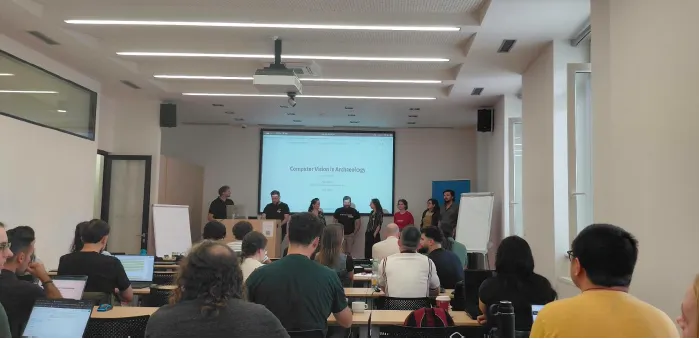
The Institute of Archaeology team opening the Training School on Monday, 14 September 2026. (Photo credit: Cherene de Bruyn).
Throughout the week, the theory sessions were paired with coding exercises, using Google Colab, allowing us to put into practice what was discussed in the lectures. We started working through the fundamentals of computer vision and image annotation to more advanced applications of machine learning, working with a range of archaeological datasets along the way. Each day we explored and discussed how machine learning and computer vision can be used to explore the human past and material culture, including some of the challenges, opportunities and pitfalls that might arise. For me, the combination of practical exercises and varied applications was particularly valuable, providing techniques and ideas that I can take forward into my PhD research and future projects.
Monday (14 September 2026) was spent getting everyone on the same page regarding the basics of computer vision. This included group discussions, which gave us the opportunity to get to know the other participants, while also introducing us to the different projects and research questions being explored across the group. After lunch, this was followed by sessions involving ‘Coding with agents’ and ‘Python for computer vision tasks’. These sessions introduced practical approaches to properly manage and organise code, directories, and data, not only so that it can be saved and accessed easily but also to develop good practice for future replication and publication. And of course, in true archaeology fashion, no first day is complete without the mandatory Kick-off Social, complete with Czech beer and snacks, on the terrace of the Institute of Archaeology.
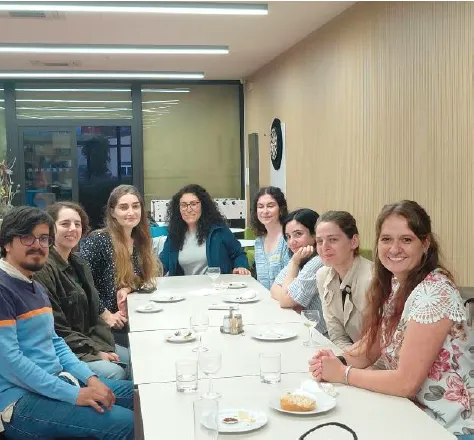
Getting to know each other over good food and drinks at the Kick-off Social. (Photo credit: Cherene de Bruyn).
Tuesday morning (15 September 2026), we began exploring some of the potential applications of computer vision, starting with annotating images. Even though there were slight hiccups with technology (it happens…), everyone was eager to put what we had learned into practice, including through Archaeotag, a mobile app game that challenges users to annotate archaeological images in a little friendly competition.
In the afternoon session, eight participants, including myself, presented talks on our research. My presentation was titled ‘The Fast and the Shallow: Drone Images for Clandestine Grave Location’. It offered a snapshot of my own journey from archaeology into forensic research at Liverpool John Moores University (UK) (LJMU), while also providing a glimpse into some of the approaches I am exploring to combine computer vision with drone imagery to locate clandestine graves. The presentation session showcased the diversity of research being undertaken across the group and highlighted the many applications of machine learning and computer vision in archaeology. It also provided an insight into the original work being undertaken by the different research groups represented at the training school.
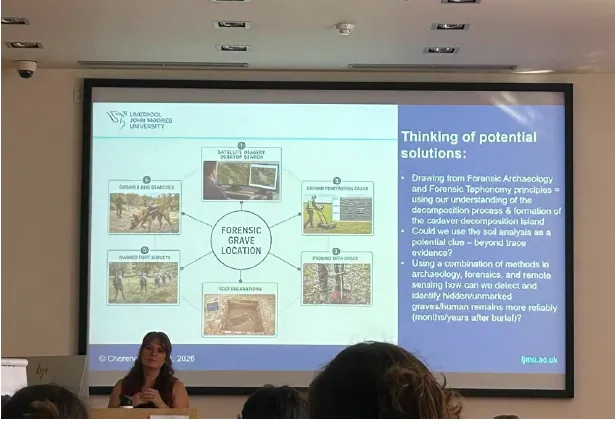
Presenting my PhD research during the student presentation session. (Photo credit: Ashley Green).
Wednesday (16 September 2026) was dedicated to analysing a microscopic image dataset, which provided an opportunity to see how computer vision can be used to investigate archaeological material at a microscopic scale, offering a different perspective on the past. Before lunch, we also had a tour of the Institute of Archaeology research labs and facilities. After a hard day’s work, everyone geared up for a historical tour of the city of Brno. Some of the sights visited included the Brno dragon, wheel, and pinnacle (complete with some old town legends), the Old Town Hall (with its crooked spire), the Parnas Fountain in Zelný trh (the Vegetable Market square), and the Cathedral of St Peter and Paul. Ending the day on a high note, the tour concluded at a pub where we enjoyed some much-deserved refreshments.
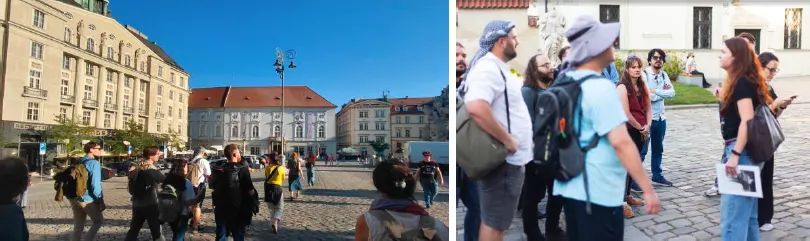
Left: The group walking through the historic city centre of Brno. (Photo credit: Cherene de Bruyn). Right: Pausing to learn about the history of Brno’s sights and architecture. (Photo credit: ATRIUM team).
I particularly enjoyed the Thursday morning session looking at computer vision and satellite images, mostly because these skills will be of immense value for my own PhD research at LJMU. The session demonstrated how computer vision can be applied to large-scale imagery, providing new ways of identifying and analysing features across the landscape. After lunch, we turned our attention to rock art images and explored how approaches in computer vision can be adapted to investigate this dataset type.
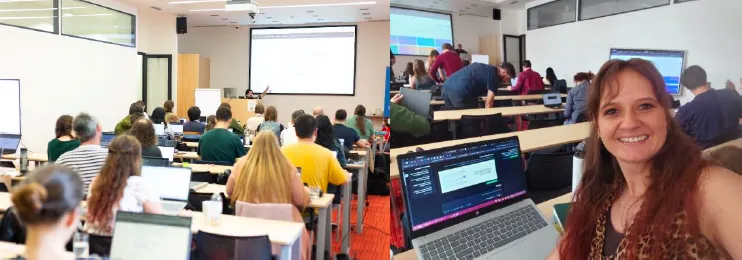
Left: Everyone concentrating hard during one of the lectures. (Photo credit: ATRIUM team). Right: Getting ready for the final day’s session. (Photo credit: Cherene de Bruyn).
The week in Brno went by far too quickly, most likely due to a combination of good food, good company, and an exciting training programme. While a week is certainly not enough time to become fully proficient in the mechanics of computer vision, the breadth and depth of the lectures and practical sessions ensured that participants left with a broader understanding of the techniques and fundamental skills needed to continue developing their own work. These skills are transferable across the broad spectrum of disciplines within and adjacent to archaeology and the digital humanities. While the training was the main focus, some of the highlights also came from the informal socials organised on a whim by participants during the week, as we continued to explore the culinary offerings and nightlife of Brno. I am incredibly grateful to the ATRIUM Project and MAIA COST Action for supporting and funding such a valuable training school. A big thank you also to Petr Pajdla, Ronald Harasim, Anastasia Eleftheriadou, Ashley Green, Filip Hájek, Zuzana Kopáčová, David Spáčil, Vít Kozák and Tereza Siková, for organising such an enriching experience!
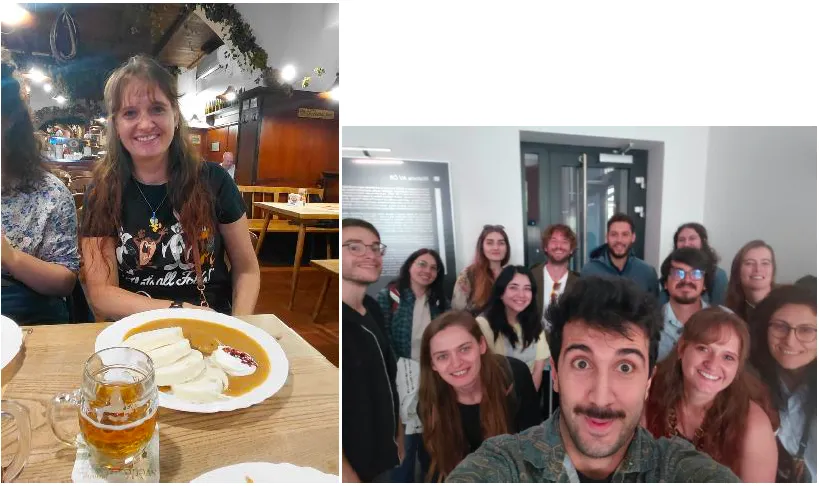
Left: Enjoying a traditional Czech beef dish with dumplings, cranberries and cream, paired with a pivo (beer). Right: Final-day shenanigans and goodbyes as we head back to our respective homes. (Photo credit: Cherene de Bruyn).